

Simogo Legacy Collection


/

/


Title:
Simogo Legacy Collection
Genre:
Compilation
Release date:
Dec 2, 2025
From cute arcade novelties to innovative text-based thrillers and acclaimed fourth wall-breaking stories, Simogo Legacy Collection is an eclectic celebration of Simogo’s past, featuring faithful renditions of seven games released on mobile platforms between 2010 and 2015.
• Kosmo Spin
• Bumpy Road
• Beat Sneak Bandit
• Year Walk (+ Year Walk Companion)
• DEVICE 6
• The Sailor’s Dream
• SPL-T
Additionally, Simogo Legacy Collection features bonus content with thoughtfully curated curios from Simogo’s wide-ranging history.
• Year Walk Bedtime Stories for Awful Children – E-book
• The Lighthouse Painting – Audio drama Podcast
• Music – Tracks from Simogo’s history, including previously unreleased tracks
• Images – Illustrations from Simogo’s archive
• Year Walk Prototype – Playable prototype
• Bumpy Road Prototype – Playable prototype
• Rollovski Prototype – Playable prototype
• The Sensational December Machine – Playable short story

Gameplay & Development
For many years we have talked about how we should approach the issue of preserving our mobile games, which are in constant danger of disappearing or ending up being unplayable with new OS versions or hardware configurations. We always thought that making a collection for consoles and PC would be the best solution, but the timing was never right as we were always busy with new projects or prototypes.
Although we were eagerly prototyping after finishing the development of Lorelei and the Laser Eyes, we decided to set the search for new ideas aside to finally discuss how we should tackle a potential Simogo collection. Over the years we had talked about “remaking” every game, designing new controls and custom solutions for every little design quirk each game had, but we quickly came to the conclusion that this approach would not only be very time consuming—it wouldn’t serve the actual purpose, which was to preserve our games.
As we originally developed the games on PC we had used mouse to simulate touch, and knew that it was a competent alternative to touch controls. But, we felt hesitant that the original experience would not be able to be truly replicated. We also had to find ways to simulate motion controls and multi-touch , which were features that were used in some of the games. On Nintendo Switch, that has touch screen with multi-touch and motion control interfaces, and is easy to hold in any orientation in your hands in handheld mode, we knew we could replicate the original experiences of the games. But, we still needed to figure out how the games would be interacted with on TVs and PC screens, and how we would handle orientation changes. We decided early that we wanted everything to be on a system-level, so that no games differed from each other in their implementation. We came up with the idea of a virtual device, which players could interact with as if it was a device in their hands using a cursor.
While it was sparsely used by only a few games, we still had to solve multi-touch. We often make design decisions by posing questions, and this time a question arose quite naturally: What if the player had two cursors? As we had already implemented Wii Remote style pointer controls using one Joy-Con, the idea of using a second Joy-Con to control a second cursor came naturally. We brought this idea to dual-stick gamepads as well, and decided to let players use a second cursor using WASD on the keyboard on PC (while controlling a cursor with the keyboard is a little fiddly, we think it was an acceptable compromise, as the second cursor is so rarely used).
When Nintendo Switch 2 and its new mouse-enabled Joy-Con 2 controllers were revealed, we were very eager to get started on development for it, so we could implement dual mouse controls. With the implementation of two cursors and virtual device in place, we felt that we had come up with a solution in which the interaction with the collection itself had become a satisfying element of play that felt both novel and joyful.
There were lots of technical hurdles of compiling all the games into one game. The biggest design challenge was to cover for all the different setups and ways we could imagine that people would play the game. This led us to implement lots of settings, such as being able to rotate the entire input system to accommodate for people being able to manually rotate their TVs or PC screens, or playing with mouse controls with the Nintendo Switch 2 systems standing vertically.
We wanted Simogo Legacy Collection to be the definitive window into the history of earliest years of Simogo. For this reason we decided to include all the side projects we had made (even including some non-mobile prototypes) as well as music and images, to fully paint the picture of the first era of Simogo.

Early in the development process we had been talking to Lost in Cult about making a book about our history. The book, Heartbeats, Dreams and Laser Eyes: 15 Years of Simogo, became like a sister-project to Simogo Legacy Collection. Developing the compilation and making interviews for the book became a good way for us to look back, and summarize Simogo first 15 years. Heartbeats, Dreams and Laser Eyes: 15 Years of Simogo is available to pre-order and is releasing in 2026.
Simogo Legacy Collection was released December 2nd 2025, which is the same date as we released our first game, Kosmo Spin. The Nintendo Switch 2 Edition is a free upgrade pack, if you own the Nintendo Switch version.

Images


There were several visual nuts to crack with Simogo Legacy Collection. First of all, we needed to decide how to present the games, as they had been designed to boot in specific resolutions and aspect ratios, which could not be changed as you played. It took a lot of work to implement being able to change between 16:9 from the phone versions and 4:3 of the tablet versions during gameplay.
Because of the many resolutions that we knew we needed to support, we also needed to find a way to make all of our minimalistic menus scale nicely, without either being blurry when scaled up or appearing crunched when scaled down. Magnus Jensen had already created shaders that allowed UI elements to have rounded corners (which we could animate) and circles, and we soon realized that the same type of shaders could be used to allow other UI elements to scale nicely.
Another problem we needed to solve was to keep the presentation coherent, as the games and their visuals widely differ. Many years ago, we made some minimalistic art based on Kosmo Spin, Bumpy Road and Beat Sneak Bandit, which we printed on big foam boards. After a few days, they fell down from the walls, and were quite badly damaged in the corners. We decided to cut them out into smaller pieces, which made them look like record covers… or app icons. The prints in our office caught Åsa Wallander’s eye, as she was designing the Simogo Legacy Collection menu. By redesigning every app icon we were able to give the compilation a cohesive visual identity. For a while, we talked about being able to switch between “classic” and “new” icons in the settings, but instead opted to keep the original icons on the individual games’ landing pages.

Videos
We announced Simogo Legacy Collection through a “Simogo 15th Anniversary Special”, which we imagined as a DIY version of a typical game company presentation, in the style of a Nintendo Direct.
Leading up to the launch, we made short videos from YouTube shorts and Instagram, which used the live action footage we had previously filmed for the 15th Anniversary Special.

Music & Audio
Daniel Olsén created the menu audio and arranged one song from every game that would play in the background as you browsed the menus. Together we compiled a list of preferred tracks from each game. This list wasn’t necessarily a list of the song we liked the most, but rather which would fit the atmosphere best. We wanted the entire experience to sound like an intimate cocktail party, with very few instruments—preferably only organ, drums and bass. Inspirations included the soundtrack from the Wii (such as the tunes from Mii Channel and Wii Shop Channel) and instrumental Nordic music, such as Svaneborg Kardyb and Hansson & Karlsson.
Every song was arranged to be equal in length and BPM, so that they could seamlessly blend into each other, to make it feel like a band was constantly jamming. As a bonus, we think this feature would allow Simogo Legacy Collection to be used as background music in other contexts, by just leaving the game on in the background at a social gathering or maybe a vernissage.
Evergreen Ride from Bumpy Road
(Arrangement by Daniel Olsén, original by Simon Flesser)
Vaggvisa from Year Walk
(Arrangement by Daniel Olsén, original by Daniel Olsén)
The Sailor’s Theme from The Sailor’s Dream
(Arrangement by Daniel Olsén, original by Jonathan Eng)

Collection Credits
Programming
Magnus “Gordon” Gardebäck
Programming
Magnus Jensen
Art & design
Simon Flesser
Art & UI
Åsa Wallander
Sound & music
Daniel Olsén

Reviews & Press
Reviews
Metacritic (Switch 2) 88
Opencritic 90
The Guardian 5/5
NintendoLife 9/10
Nintendo World Report 9/10
Nintendo Insider 10/10
Checkpoint Gaming 9/10
AnaitGames 9/10
Polygon
Press
The Verge – A love letter to glory days of iPhone gaming
Nintendo Insider – Simogo Legacy Collection Interview
Nintendo World Report – Simogo Legacy Collection (Switch) Hands-On Preview
Nintendo World Report – Simogo Developer Interview with Co-Founder Simon Flesser
AnaitGames – Simogo Monográfico #17
Interview : Simogo revient sur Simogo Legacy Collection et son arrivée sur Nintendo Switch 2
Nöjesguiden – 15 års trogen tjänst
Sydsvenskan – Simogo räddar sina gamla spel med nysatsning – och blir bok
Age Ratings

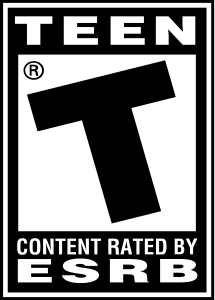
ESRB content descriptors:
Mild Violence